When I started trying to promote my own artwork online I kept coming across other people's art that amazed or compelled me in one way or another. This blog has been a way for me to practice thinking and writing about art, as well as learning more about my peers and all the incredible art that is being made out there.

Search for an Artist on this blog (or cut and paste from the list at the bottom of this page)

Thursday, September 29, 2011

Narangkar Glover

"Shangri-La Girls School: Nalwa House Dorm", 2010, 60 x 80 inches, oil on canvas

"Shangri-La Girls School: A Thousand Stairs", 2010, 60 x 60 inches, oil on canvas

"Shangri-La Girls School: Garhwali Himalayas", 2010, 60 x 60 inches, oil on canvas

 "Shangri-La Girls School: Field Hockey", 2010, 60 x 80 inches, oil on canvas

Shangri-La Girls School: attari house plotting domination, 2010, oil on canvas, 48 x 48 inches

In her ongoing series, "Shangri-La Girls School" Narangkar Glover paints memories that transform themselves into myth. The roots of these images, we are told, lie in a biographical past, a religious upbringing and a girls' boarding school in India. But they are paintings after all. Not memories. Her use of simplified forms and a conscious naive approach to drawing, help to guide us away from seeing them as representations of a reality. They take on a symbolic resonance, so that they are capable of carrying meaning. This is how mythmaking is always done. No one confuses myth with verisimilitude. The latter can easily impress but the former is much harder to accomplish. So brava to Narangkar Glover for taking a unique experience and giving us myths by which to touch that experience with our own.
Her work was featured in last years New American Paintings (#93) and is currently include in a group show at Andrea Schwartz Gallery in San Francisco.
To see more of her work online go to her website: www.narangkar.com

Monday, September 26, 2011

Maysey Craddock

"Sanctuary"  gouache and thread on found paper  38" x 50.5"  2011

"Ninth ward (after Friedrich)"  gouache and thread on found paper  38" x 69.5"  2010

"Held (orchard and rail)"  gouache and thread on found paper  50" x 38"  2011

"Rupture (ashes and light)"  gouache and thread on found paper  38.5" 51.5"  2011

"The Back of Beyond"  gouache and thread on found paper  69.5" x 89"  2009

A friend of mine was recently in New York and saw this work by Memphis artist, Maysey Craddock at Nancy Margolis Gallery (the show will be up until Oct. 15, if you happen to be out that way). Her work depicts the nether world that exists in the wake of human industry, where vines and shrubs establish themselves among discarded and decaying structures and old fences divide empty space form empty space. Her studio is set in such a place, in an old medicine factory, last in a row of empty warehouses at the end of a dead-end street. She works on found paper, mostly old paper grocery bags sewn together with silk thread, giving the work a textural quality that echoes the content. The images are derived from photographic references and painted in simplified graphic forms with gouache. One can imagine these paintings rattling quietly, stuck by a breeze against some old chain link fence. The message of course, is that these forgotten spaces hold their own kind of beauty for those who look, because they are in transition, actively changing from one kind of place into another.
You can see more of her work at www.mayseycraddock.com

(thanks Devon.)

Thursday, September 22, 2011

Josh Dorman

"The Big Picture"  Ink, acrylic, graphite, collage on panel  33" x 34"  2011

"Tower of Babel"  Ink, acrylic, oil, antique paper on 32 adjoining panels  96" x 48"  2008
"A Cautionary Tale"  Ink, acrylic, collage on panels  36" x 68"  2008

"Night Fishing II"  Ink, acrylic, collage on panel  34" x 36"  2008

"A Mighty Rain"  ink, acrylic, collage on panel  33" x 34"  2011
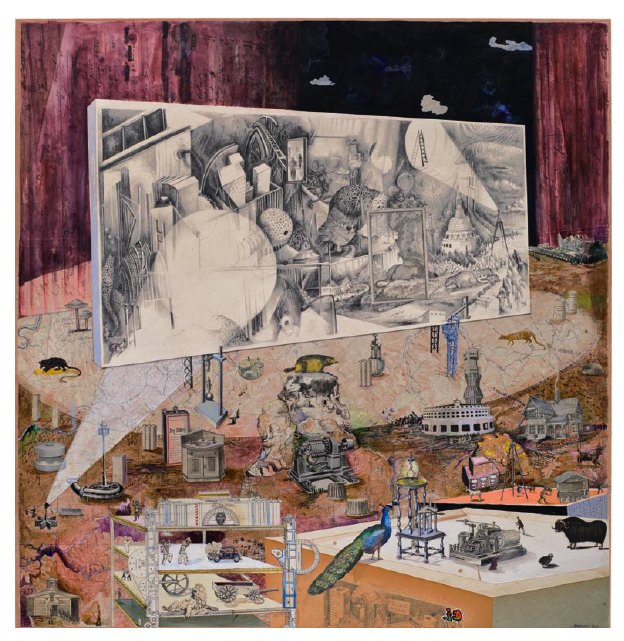
Josh dorman is an obsessive collector of old paper, especially pre-photography printed materials. He hordes outdated topographic maps and textbooks, technical illustrations and the like. Then, in a combination of collage and painting, he builds images rife with subtle and often random associations that nonetheless come together with compelling completeness.  Because of the nature of his material, his work is rife with images of natural history and technology. The two themes square off against each other in the eternal conflict that defines mankind's unique condition; both creator and creature, master and manipulator of the environment while at the same time as dependent upon it as any other living thing. But there is far too much room in his work to get stuck on general themes like this. Part of the fun (and yes, there is a definitely an element of fun here for all the riffs on human hubris), is to take the time and look through the details. Some of the images here can be viewed larger, but I recommend going to his website where you can view the images really large and spend a little time poring over his meticulous presentation of a fine collection indeed.
www.joshdorman.net
 (better yet, if you happen to be in NYC between now and Oct. 22 swing by Mary Ryan Gallery over in Chelsea to see work in person.)

Tuesday, September 20, 2011

Daniel Dove

"Kells"  34" x 54"  oil on canvas  2010

"Exploded View"  oil on canvas  50" x 68"  2009

"Volcano"  oil on canvas  48" x 96"  2007

"Wireherd"  oil on canvas  72" x 96"  2007

"Vanishing Point"  oil on canvas  66" x 96"  2010
Daniel Dove's work recently received a special spotlight and review in New American Paintings #95. It's a well deserved honor for an enormously impressive painter. These monumentally sized canvases capture both the grandeur and decay of the modern urban landscape. And somehow implied in this, there seems to be a metaphor for the grandeur and decay of painting itself. His work is clearly rooted in the representational but embraces abstraction. And while the work is refreshingly (to me) narrative, the images work as simple visual constructs. I apologize if my language sounds more like pretentious art-babble than usual but I'm really at a loss for words.  And so I guess I really don't have much more to say, other than I highly recommend looking through the rest of the work on his website: danieldove.com