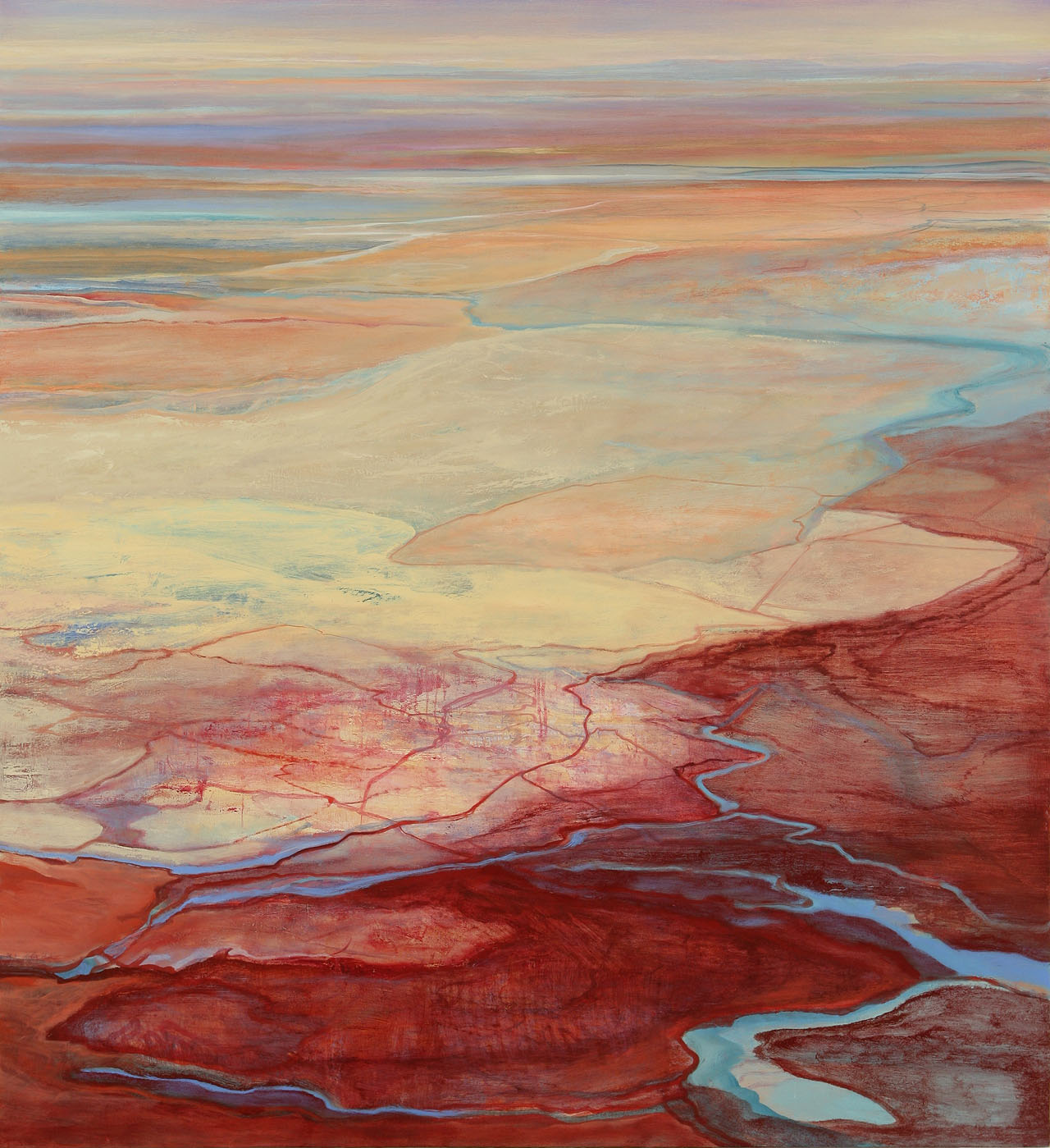
When I started trying to promote my own artwork online I kept coming across other people's art that amazed or compelled me in one way or another. This blog has been a way for me to practice thinking and writing about art, as well as learning more about my peers and all the incredible art that is being made out there.

Search for an Artist on this blog (or cut and paste from the list at the bottom of this page)

Showing posts with label environmentalism. Show all posts

Monday, November 14, 2011

Masakatsu Sashie

"Stove"  2011 oil on canvas 162 ×194cm

" ジャンボリー"   2011 oil on canvas 116.7 ×116.7cm


"Planet"   2010 oil on canvas 162 ×130.3cm


"Bazaar"   2010 oil on canvas 130.3 ×194cm

A lot of contemporary art here in the U.S. is addressing the condition of our post-industrial world and the decay and destruction of our environment. There's an obsession with decrepit buildings and overgrown infrastructure. It's no surprise that artists in Japan would take on some of the same themes. Masakatsu Sashie has an interesting take on it though. In many of his paintings a death-star-like sphere of urbanity floats above a desolated world. In another the urban is represented by a battle ship plying a sea of human refuse. The message is clear: As cities grow, the planet dies. Subtlety is fine thing but sometimes the message is more deserving of a hammer-like delivery, and these arresting images do just that. You can see more at sal-s.com

The artist was also featured on www.artistaday.com where I first came across the work.

Tuesday, October 4, 2011

Philip Govedare

"Excavation #4"  oil on canvas  70" x 64"  2010

"Excavation #5"  oil on canvas  48" x 90"  2010

"Excavation #6"  oil on canvas  66" x 59"  2010

"Project #3"  oil on canvas  70" x 64"  2010

"Tundra"  oil on canvas  19" x 80"  2010

Philip Govedare's paintings describe vast open alien landscapes, the kind of thing one expects to see beamed back to us from low orbiting satellites sent to Io or Ganymede. But for the hinted ribbon of a road here and there they could be just that. But scenes of mountain top removal in West Virginia or the Canadian tar sands can seem equally strange, and despite the grim message of their existence there is something awesome and fascinating to them as well. These paintings, largely imagined, capture that sense of awe struck wonder and appalled disbelief at what we are capable of, transforming the very surface of the planet on which we live. They are a fascinating meditation on what a landscape means.
To see more go to: www.philipgovedare.com

Monday, September 26, 2011

Maysey Craddock

"Sanctuary"  gouache and thread on found paper  38" x 50.5"  2011

"Ninth ward (after Friedrich)"  gouache and thread on found paper  38" x 69.5"  2010

"Held (orchard and rail)"  gouache and thread on found paper  50" x 38"  2011

"Rupture (ashes and light)"  gouache and thread on found paper  38.5" 51.5"  2011

"The Back of Beyond"  gouache and thread on found paper  69.5" x 89"  2009

A friend of mine was recently in New York and saw this work by Memphis artist, Maysey Craddock at Nancy Margolis Gallery (the show will be up until Oct. 15, if you happen to be out that way). Her work depicts the nether world that exists in the wake of human industry, where vines and shrubs establish themselves among discarded and decaying structures and old fences divide empty space form empty space. Her studio is set in such a place, in an old medicine factory, last in a row of empty warehouses at the end of a dead-end street. She works on found paper, mostly old paper grocery bags sewn together with silk thread, giving the work a textural quality that echoes the content. The images are derived from photographic references and painted in simplified graphic forms with gouache. One can imagine these paintings rattling quietly, stuck by a breeze against some old chain link fence. The message of course, is that these forgotten spaces hold their own kind of beauty for those who look, because they are in transition, actively changing from one kind of place into another.
You can see more of her work at www.mayseycraddock.com

(thanks Devon.)

Tuesday, September 20, 2011

Daniel Dove

"Kells"  34" x 54"  oil on canvas  2010

"Exploded View"  oil on canvas  50" x 68"  2009

"Volcano"  oil on canvas  48" x 96"  2007

"Wireherd"  oil on canvas  72" x 96"  2007

"Vanishing Point"  oil on canvas  66" x 96"  2010
Daniel Dove's work recently received a special spotlight and review in New American Paintings #95. It's a well deserved honor for an enormously impressive painter. These monumentally sized canvases capture both the grandeur and decay of the modern urban landscape. And somehow implied in this, there seems to be a metaphor for the grandeur and decay of painting itself. His work is clearly rooted in the representational but embraces abstraction. And while the work is refreshingly (to me) narrative, the images work as simple visual constructs. I apologize if my language sounds more like pretentious art-babble than usual but I'm really at a loss for words.  And so I guess I really don't have much more to say, other than I highly recommend looking through the rest of the work on his website: danieldove.com

Friday, September 16, 2011

Adam Friedman

"The Elemental and Fundamental"
Acylic, Screen Print, Gel Transfers, and Collage on Panel  18"x14"  2010


"Endurance of the Farallons"
Screen Print, Acrylic, Gel Transfers, and Collage on Panel  14"x20"  2009


"An Icelandic Orogeny"
Acrylic, Screen Print, Gel Transfers, and Collage on Panel  17"x31"  2010


"No Vestige of a Beginning, No Prospect of and End"
Screen Print, Acrylic, Gel Transfers, and Collage on Panel  16"x16"  2010


"Reclaiming Everest
Acrylic, Screen Print, Gel Transfers, and Collage on Panel  26"x15"  2010

The artist in my previous post (Robert Minervini) wrote me to recommend another artist in my own town of Portland, Oregon, Adam Friedman. So here's his work. He employs an interesting combination of media but as is typical with me, I tend to hone in on content. One notices very quickly repeated references to landscape, environment and especially geology. One of the most fascinating and difficult aspects of geology is it's dilated time scale. In geologic time, the human presence on earth is a barely perceivable blip and in geologic terms our impact upon the earth is negligible. The gradual processes of the earth's crust, it's formation, it's folding and unfolding, it's slow parade of eons has gone on long before we existed and will continue long after. This is his central theme. His occasional forays into anthrocentric environmental concerns is almost a shrug. Will we destroy ourselves? Possibly. Are we bringing about a mass extinction of unique lifeforms? Almost certainly. Ultimately the earth, and life as a whole, will barely notice we were ever here. For some, including Adam Friedman, this thought is a source of deep and abiding comfort. We are not the center of creation. We are merely witnesses to it's vast scale and scope.
To see more, go to his website: artbyadamfriedman.com