When I started trying to promote my own artwork online I kept coming across other people's art that amazed or compelled me in one way or another. This blog has been a way for me to practice thinking and writing about art, as well as learning more about my peers and all the incredible art that is being made out there.

Search for an Artist on this blog (or cut and paste from the list at the bottom of this page)

Showing posts with label Landscape. Show all posts

Thursday, April 17, 2014

Kris Manzanares

"Girl at Rest / Speed"  oil on panel  48" x 32"  2014

"Fight"  oil on panel  14" x 14"  2014

"Eggplant"  oil on panel  14" x 18"  2014

"Leaving Austin"  oil on panel  23" x 14"  2013

"The Mustard Eaters"  oil on birch panel  32" x 49"

This is a post that's long overdue. Turns out I started to write one in 2012 but got sidetracked and apparently forgot that it never went up. I knew Kris in Arizona more than 15 years ago when she was a sculptor. Having children made that work more difficult but she found time and space to paint instead, a difficult transformation that she made look all too easy. It also transformed the very nature of her art, much of which involves metaphorical narratives based on the lives of her children. But her work is as much about atmosphere and technique as well. She combines very controlled drawing and realism with expressionistic brushwork, the backgrounds often dissolving into pure abstraction. There's something about them that really captures the bright heat of summer days in the southwest. But whether she's painting figurative psychological narrative, a simple landscape or a still life, they are all clearly echoes of her personal life, the small moments and seemingly insignificant objects that together constitute a life.
You can see much more of her work at krismanzanares.com
and if you happen to be in the Phoenix area go see her work in person at Paul Scott Gallery in Scottsdale.

Monday, April 7, 2014

Gayle Bard


"Bainbridge Island Cloud"

"Skagit Flats"

"Franklin County"  2013 oil on canvas 42.5 x 54"


"Bateman's East Sussex"

"It's a Boy"
Gayle Bard's paintings explore volume and light, most recently in the form of vast cloud forms looming over the land. The land is often, but certainly not always, somewhere in the Pacific Northwest. She currently lives and works on Bainbridge Island across Puget sound from Seattle, but she is originally from the midwest, and one senses that her youth accustomed her eye to open spaces. Her landscapes are less about the land itself that they are about abstract three dimensional space configured in two dimensional representation. And yet a real sense of place matters as well. The colors of the northwest, a subtle but radiant array of blues, greens and grays, suffuse her work. The sky in her paintings is not simply occupied by the occasional cloud but is a true atmosphere, volumes of air and moisture fading into each other and through which we all move and breathe, more like fish in the sea than figures moving about through empty space. The air is as real and present as the land below. And when it comes to light, she seems to relish not the scintillating prismatic wonder of it portrayed so famously by the impressionists, but the way it fades, and how colors ebb into gray when the sun is only indirectly present.

Her career has spanned over 40 years and covered far more territory than what I've described here, including a wide array of subject matter and approaches including installations. I'm sad to say I've only just discovered her and I wish I had been able to see a recent retrospective of her work at the  at the Bainbridge Island Museum of Art. If you feel the same and happen to be in the area, you're in luck. She currently has work on display at Linda Hodges Gallery in Seattle.


Friday, March 28, 2014

Eric Aho

French Forest, 2012
Oil on linen, 52 x 48 inches

March Eight Hemlocks, 2013
Oil on linen, 36 x 30 inches

Nocturne (Apex), 2011
Oil on linen, 36 x 30 inches

Ptarmigan, 2013
Oil on linen, 48 x 60 inches

Small Lynx, 2013
Oil on linen, 36 x 30 inches

Eric Aho's work has moved more deeply into pure abstraction over the years and yet it remains deeply embedded in the landscapes that the artist so clearly loves. The line between abstraction and representation is more like a vast gray zone between two peculiar and, for my money, less interesting extremes. Magritte made it clear representational art is still essentially abstract. A painting of a pipe is not a pipe. It is a painting, an amalgam of shape, line and color. Aho makes it clear that an unrecognizable arrangement of colors, shapes and marks can still be a powerful expression of things that exist in the real world. His paintings seem to blend the old romantic landscape traditions that attempted to evoke the awe and wonder one can experience in the face of the vastness or subtleties of the natural world, with the expressive modes of de Kooning and other abstract artists. The degree to which he bridges this seemingly enormous gulf is the key to his success. JMW Turner occasionally accomplished something similar over 150 years ago before pure abstraction was even considered a viable possibility. But since then this kind of synthesis has not been particularly well explored. Which is unfortunate, since it strikes deeply into the essential truths that painting is capable of and humbles a simple narrative artist like myself.

You can see some wonderful work on the artist's website (ericaho.com). Much of it is older but it's well worthwhile to see the gradual shift in his work from representation to abstraction. For more recent work check out DC Moore gallery.

I posted his work once before way back in November2009

Friday, March 14, 2014

Peter Rotter

After The Storm 48×60, 2012

Spring Greens, 36 x 36, 2013

Whale Island 36×60 Oil on Canvas

Winter Forest, 36 x 60, 2012

Winter Sunset, 36 x 60, 2013

And now we turn 180 degrees from abstract conceptualism to that most traditional of forms, the landscape painting. In this field it is not always easy to pick out the excellent from the merely good. But to me Peter Rotter's work stands out from the very very crowded field. His technique combines impressionist brushwork with a photographic and sometimes even graphic sensibility. The simplicity of his compositions accentuates the strengths of his technique and the brushwork is clearly apparent even in these low resolution digital images. The paint is used to depict both the edges of physical forms and the shifting hues of light with equal and naturalistic ease. The overall effect is a powerful evocation of the northern landscapes of Ontario where the artist lives and works.
You can see more at his website: www.peterrotter.com
And he'll be having a solo show opening March 22 in Wellington, Ontario at Studi House PEC.

Tuesday, March 4, 2014

Julian Bell

"Exercises at Imber"  2004

"Delhi Metro"  2007

"The Skylit Room"

"State Offices, Zadar"

"The Arrest at Nevada Bob's"  1999
Julian Bell is a British painter who enthusiastically embraces representation and narrative and finds plenty of fresh energy in that age old effort. He says he's "interested in the funny things people do on the earth," and that seems like a pretty good summation of his style and subject matter, both of which are widely varied, from landscapes to interiors and figures, depicted in rough gestural drawings or tight realism, rigid formal compositions or looping fish-eyed panoramas. The unifying element through all of it is a fascination with the comically vast range of human behavior and our often bizarre transformation of the landscapes around us. The human world seen through Julian Bell's eyes is neither a horror show, nor is it one of awe and wonder. It may occasionally strike you as one, or neither or both, but ultimately it is simply a fascinating place of unlikely peculiarities. 
Enjoy.

You can see more work at his website: http://www.jbell.co.uk
or at: http://www.stannesgalleries.com/bell.html

Julian Bell is also a writer and author of the recent history of art "Mirror of the World".

I'd like to thank Chester Arnold to pointing me to his work.

Wednesday, February 12, 2014

Eric Joyner

"Lunch Break"

"Catfish"

"All Wrapped Up Again"

"Home Away From Home"

"Jungle Trek"
It's odd. This morning I suddenly had a craving for a donut. I don't eat donuts all that often often. But I like them. Only I'm at work and there's no place nearby to get one. So instead, I thought it was high time to revisit the work of Eric Joyner. He has turned donuts and toy robots into his personal iconography. Armed with a real talent for traditional realism, an exuberant sense of humor and a wry taste for nostalgia he has created what can modestly be described as a unique body of work. I can imagine someone saying that this isn't really serious art. To which the only reply could possibly be, hooray! Serious art can be great, don't get me wrong. But sometimes it's all just so... well, serious. It can give you a headache after a while. The perfect remedy for that sort of thing might be right here. Of course you can't fill up on donuts all the time, but every now and then they're just the thing.
His website is very complete and includes full galleries for every year going back to 2000. So go, and enjoy: ericjoyner.com

Thursday, September 19, 2013

Chester Arnold

"Cuttings"  74" x 87"  oil on linen  2012

"Small Time Operation"  46" x 56"  oil on linen  2012

"The Old Narcissus"  46" x 56"  oil on linen  2012
"60 years in the Forest"  72" x 60"  oil on linen  2012

"In the Midst of Everything"  46" x 56"  oil on linen  2013

"The Dump at Shit Creek"  18" x 22"  oil on linen  2012

When I first posted some paintings by Chester Arnold in August 2009 I admired his wit as well as his skill. But after revisiting his work recently he may be firmly ensconced among my very favorite contemporary painters. His paintings are narrative at their core, stories about human beings and the natural world they they inhabit, explore, occupy, and generally cover with debris. He relishes depicting the randomness and chaos inherent in both the natural world and the detritus of human activity. He observes one or the other, or more frequently frequently both at the same time, with genuine fascination. His portrayal of people and the messes they make is full of equal parts sympathy and disgust. These are not typical visual polemics on environmentalism. Judgment is there, to be sure, but it comes in the form of wry humor and wit, like Mark Twain piercing human foibles far better than more pompous social critics with precise and bemused observation. Arnold's vision of the natural world seems to stem in part from the romantic tradition of Caspar David Friedrich. In Freiderich's somber and serious work man is a tiny insignificant observer of the grand wonder of the world around him. In Arnold's world man is more of a clumsy oafish sort unaware and unheeding of his sublime surroundings. And yet we can't completely despise him. We empathize with his determination and grit even while shaking our heads at his folly. He is us after all.
You can see more work at the artist's website: www.chesterarnold.com
and at Catharine Clark Gallery in San Francisco

Friday, August 9, 2013

Michael Brophy


"Pacific Wonderland" series of 36 gouache paintings on paper  2012
from "Cascadia Exit" a series of 40 gouache paintings on paper

from "Cascadia Exit"

from "Pacific Wonderland"

from "Pacific Wonderland"

from "Cascadia Exit"
Last year Michael Brophy spent some time on the roads of Oregon crisscrossing the state and producing a slew of small gouache studies. Many of these are currently on display this month in Portland, Oregon. Those familiar with his work might be more familiar with his large oil canvases (often 10 feet across). But his vision scales down nicely. In them delicate lines of paint scrawl out the shapes of trees or reflections on water with a calligraphers confident ease. The scenes are rarely the epic ones that artists, photographers and tourists might be expected to gravitate to. Rather they are the ordinary scenes one often passes by without much thought. For Michael Brophy every angle, every new scene, even the seemingly emptiest (yes, especially the emptiest) is not only worth looking at, but worth recording and rendering, allowing the rest of us to see his home state through his eyes. I first posted his work in September, 2010 and he still doesn't have a website. Though there are plans in the works for one it could be a while. So for now the only place to find his work online is at Laura Russo Gallery which also where you can see the work in person if you're lucky enough to live in Portland.

Tuesday, July 23, 2013

Stephanie London

"Iceberg no.3"  oil on canvas  12" x 16"

"Iceberg no.4"  oil on canvas  12" x 16"

"Glacier"  oil on canvas  12" x 16"

"Iceberg no.6"  oil on canvas  12" x 16"

"Shipwrecked no. 2"  oil on canvas  16" x 20"

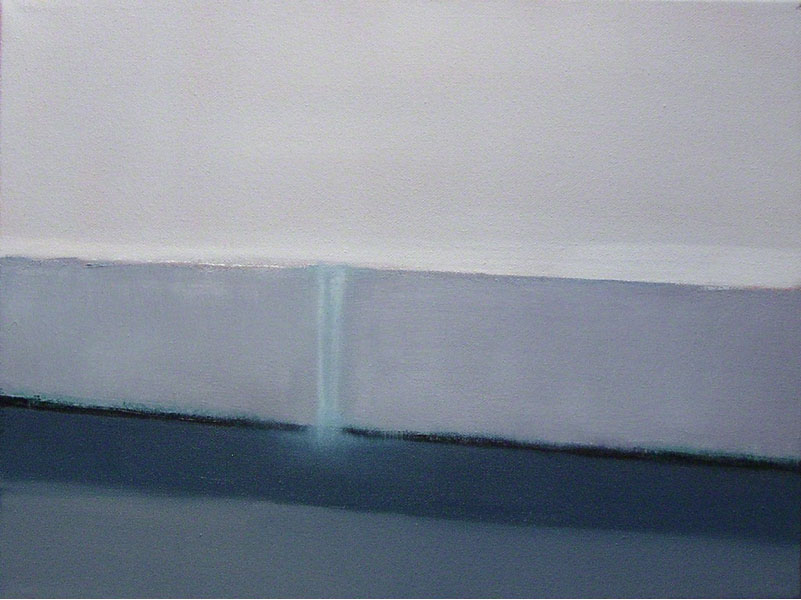
Ice, water and wind interact in the frozen seas to create a never ending source of abstract sculpted forms, forms that have obsessed many great artists over the centuries. These icebergs, ice sheets and glaciers are a perfect prompt for Stephanie London's gift of using simple shapes and subtle shifts of value and hue to create spare poignant compositions. Her work also includes more domestic still life paintings that echo this minimalist approach; an empty box, a single flower, a vase, etc.,. And she has a few semi-abstract images on her website based on simple bridge forms. But in the iceberg series her penchant for brooding meditational imagery coalesces into her most powerful work. To me they evoke an emotional state that I think is familiar to most, yet difficult to describe; a sense of welcomed loneliness or sorrow that is not a negative but rather a necessary and possibly even exhilarating process. The unavoidable analogy of the iceberg's hidden depths cannot help but come into play here. What we observe seems simple. But of course it isn't. As in all good craftsmanship, simplicity of form is often the most difficult to achieve. And like our understanding of ourselves or others, the basics of what we observe are so immediate, so fundamental as to require little or no analysis. But beyond that we recognize a profound complexity too vast to fully comprehend. That larger hidden aspect of ourselves, as in the allegorical iceberg, sometimes shifts, forever altering the visible, knowable surface, reshaping it once again into something new, evolving, changing, living.

There's more work on her website: stephanielondon.net though only a few more iceberg pieces. I look forward to seeing more.

Her work can be seen in person in New York city and Bridgehampton NY at Kathryn Markel Fine Arts or in Pasadena CA at Tirage Fine Art Gallery.

Monday, July 15, 2013

Elsa Muñoz


"Controlled Burn 1"  oil on panel  24" x 50"  2012

"Controlled Burn 2"  oil on panel  24" x 55"  2012

"Night Shore 1"  oil on panel  60" x40"  2012

"Burning Branch"  oil on panel  24" x 36"  2010

"At The Table"  oil on panel  20" x 25.5"  2011

The dark plays a prominent role in the finely crafted work of the young Chicago artist Elsa Muñoz. Not that all her paintings are night scenes or of dimly lit rooms, but there is almost always as much hidden as there is revealed. This is sometimes the case literally, as in her nearly horizonless night shore paintings, and sometimes figuratively, as in her still life of a burning branch upon a table in which no clues or details are offered to elucidate the inherent mystery. In "At The Table" both aspects are on display as the daylight coming through the nearby window illuminates just a small fragment of the seated figure leaving both her physical features and her emotional context in doubt. In her "Controlled Burn" paintings the fire, which we usually associate with light, is instead a source of smoke and haze, concealing rather than revealing the forest. It is this constant tension between the revealed and the hidden, between description and suggestion, that lends her work an emotionally powerful sense of drama.
You can see more online at her website: elsamunoz.com
and at Zygman Voss Gallery in Chicago.